
EKYAN — Engaging Kenyan Youth in Agriculture & Nutrition
Youth unemployment, falling farm productivity and poor household nutrition are one problem, not three. EKYAN answers them with one solution: a locally embedded ecosystem where young agripreneurs, public schools, farmers and markets become a single learning and economic network.
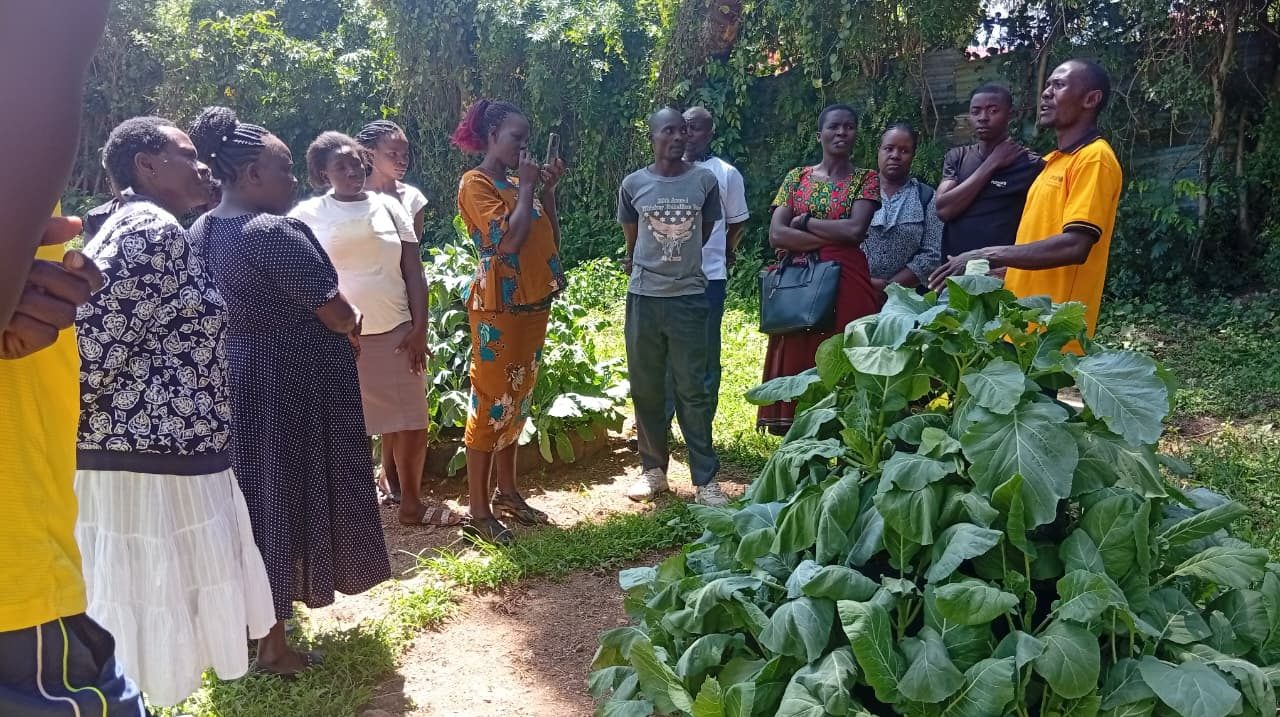

Building on impact. Expanding the last mile.
EKYAN has launched its latest phase in Kisumu County, bringing together agripreneurs and community-facing professionals from all eight sub-counties. The new phase deepens and scales the work across Kisumu, Busia and Samburu — strengthening young agripreneurs' livelihoods and extending climate-smart, nutrition-sensitive and market-focused support to more farming households.
Agripreneurs now work as trusted community-facing professionals who mobilise, train and support households, connect them to products, services and markets, follow up, and refer to agricultural, nutrition and other technical experts.
Three failures of the same food system
Kenya's agriculture employs most of the rural population, yet it fails young people, stretched farmers and family diets at once. EKYAN treats these as interconnected — because they are.
Youth without a pathway
Rural young people understand farming — what they lack is a credible route into it as a business: training, markets, tools and networks. Without one, agriculture looks like decline, and talent leaves.
Smallholders under pressure
Erratic rainfall, declining soils and rising pests squeeze productivity while public extension can't reach every farm. Farmers know better practices exist; they lack the confidence and access to change.
Monotonous farms, monotonous plates
What households eat is shaped by what they grow. Fragile, low-diversity farming systems mean poor diets — and 48.8% of EKYAN participants had never received nutrition information before the programme.
INSPIRE · SKILL · CONNECT
A place-based model anchored in public schools and delivered through youth agripreneurs, blending Kuza's digital platforms with face-to-face training, demonstration plots and community mentorship.
Inspire
Reposition agriculture as opportunity — for youth, for learners, for farming households — through visible, working examples in schools and communities.
Skill
Incubate agripreneurs through the Kuza Leadership Academy, Agribytes and county technical experts; build farmer and learner capability on 165 live demonstration plots.
Connect
Link skills to inputs, services, markets and finance — 40 private sector companies onboarded — so knowledge becomes income and adoption becomes habit.
A five-dimensional ecosystem
Each actor plays a distinct role. The value is in how they interact.
- Youth agripreneursThe human interface — training, mobilisation, services, inputs, aggregation; local enterprises with a customer base of farmers.
- Public schoolsInstitutional platforms that make agriculture visible, practical and legitimate — 50 Centres of Excellence plus 150 satellite schools.
- Young learnersThe long-term pathway: 8,008 learners who carry practices home and now see farming as a future.
- Farmers & householdsAdopters and beneficiaries of improved practices, services and market access — 55,685 unique farmers.
- Private sector partnersInputs, technologies, buyers and finance that turn local learning into real economic opportunity.

Every target met. Two exceeded.
Year 2 (2025–26) scaled the Kirinyaga pilot into Busia, Kisumu and Samburu. Figures below are from the Year 2 Final Report; cumulative programme totals since 2024 are shown at the top of the page.
| Target | What it means | Result | Status |
|---|---|---|---|
| 50 Centres of Excellence | Community agricultural learning hubs | 50 | On target |
| 400+ agripreneurs incubated | With a 50% female target | 400 · 47% women | On target |
| 8,000+ young learners | On food systems and regenerative agriculture | 8,008 | On target |
| 40,000 farmers engaged | Through agripreneur-led advisory | 51,425 | Exceeded |
| USD 500,000 agripreneur transactions | Business revenue and services | USD 553,000 | Exceeded |
| 40 private sector companies | Technology transfer and market linkages | 40 onboarded | On target |
| 3 counties | Busia, Kisumu, Samburu | 3 | On target |
What Year 2 delivered
From trainees to economic actors
400 young people were incubated and deployed as trainers, service providers, input distributors and aggregators. Median monthly income more than doubled, and 99% used EKYAN as a springboard for concrete business growth — 85% expanded an existing enterprise, 20.7% started a new one.
Public schools as climate innovation hubs
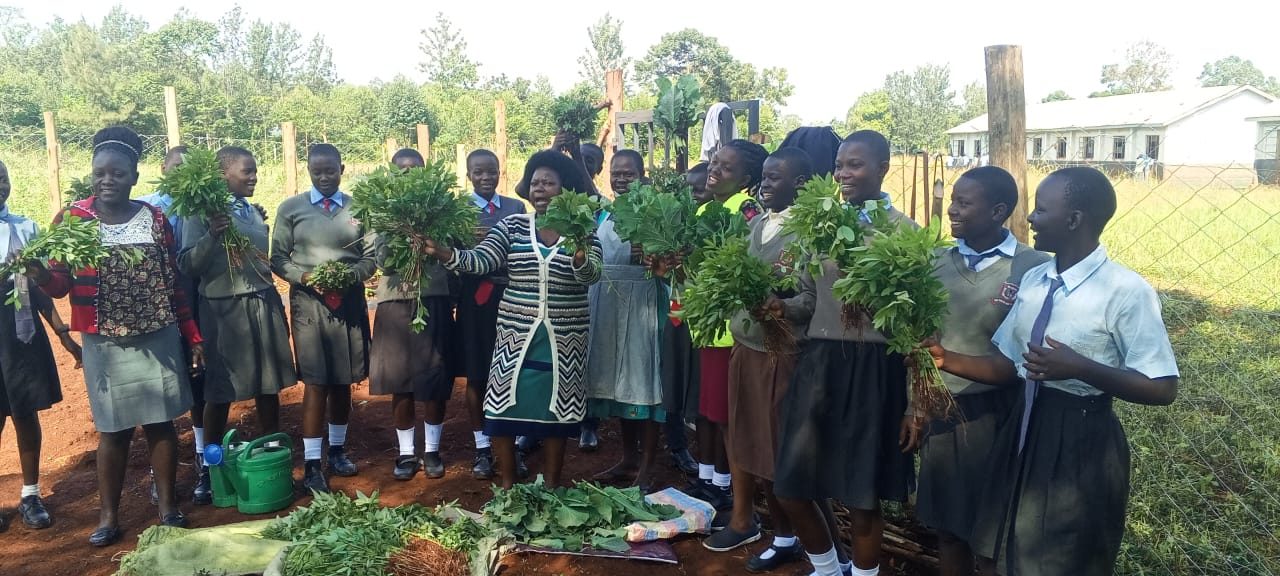
200 schools — 50 Centres of Excellence and 150 satellites — became living classrooms with 165 demonstration plots co-created by learners, teachers, agripreneurs and county officers. Agriculture moved from a peripheral subject to a weekly part of school life, and produce flowed straight into school meals.
Bundled services close the gap between learning and action
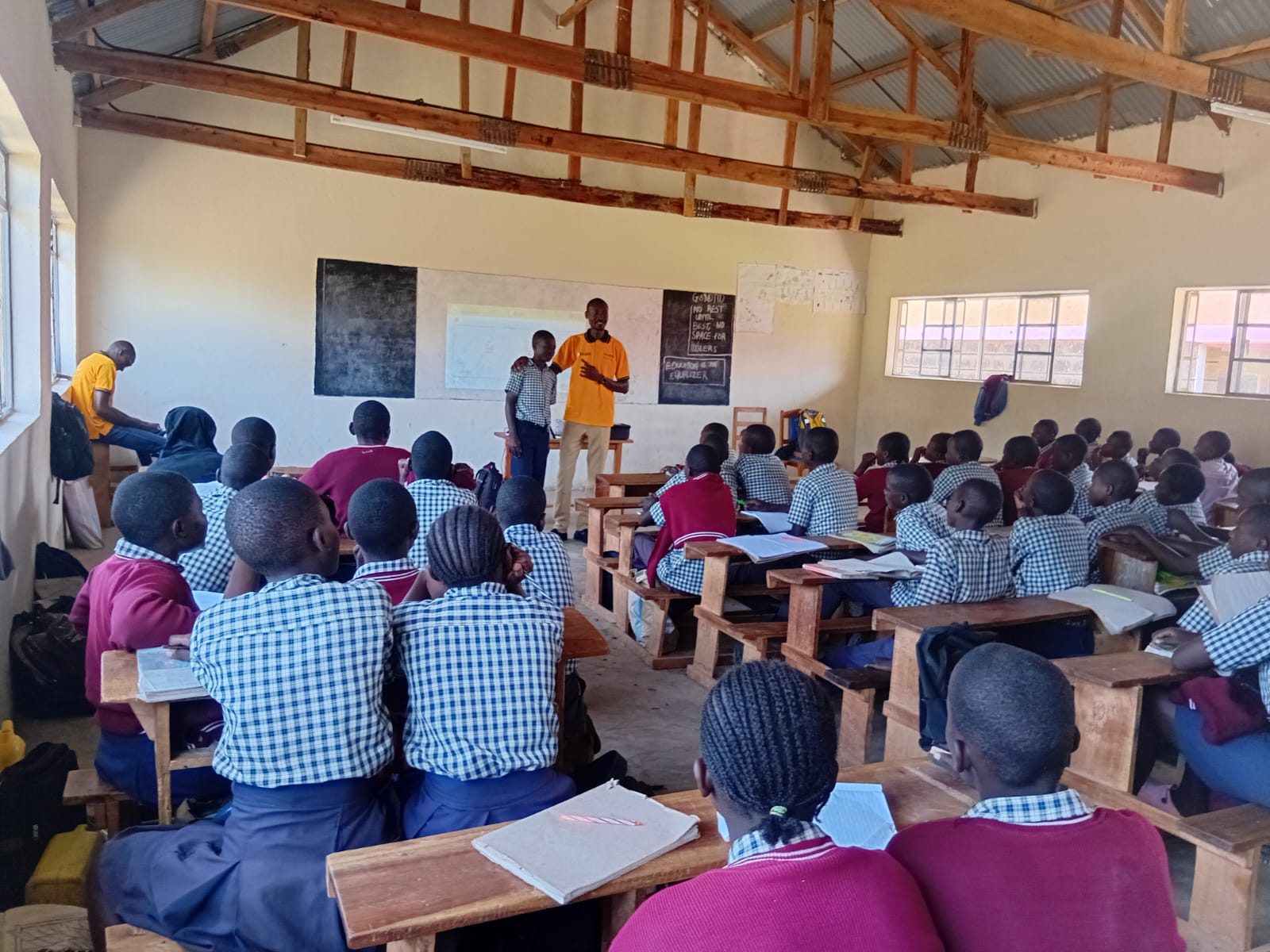
Rather than classroom instruction, agripreneurs ran visible field demonstrations, followed up on farms, and linked farmers to seed, animal health, feed, spraying, aggregation and buyers. Field verification found 66% of farmers had fully adopted new practices and were applying them consistently.
Nutrition-sensitive and climate-smart, at the same time
EKYAN proved that regenerative practice and dietary diversity can be promoted together, practically, through the same demonstration plots and agripreneur relationships that drive income. Kitchen and sack gardens, raised beds, composting and African leafy vegetables became household habits.
What goes to households
- NutritionFood groups, dietary diversity and balanced meals.
- Regenerative practicesKitchen & sack gardens, raised beds, composting, zai pits, water-smart techniques.
- African leafy vegetablesManagu, spider plant, pumpkin leaves and more — grown at home and put on the plate.
Four counties, one adaptable model
Piloted in Kirinyaga, EKYAN scaled in Year 2 into three counties chosen to test the model across very different farming systems — from lake-region mixed farming to arid pastoral lands. Today the network spans 256 public schools and 64 Centres of Excellence across all four.
Kirinyaga
High-potential, irrigated and rainfed systems off Mt. Kenya. Where school demo plots and agripreneur-led training were first tested and refined.
Busia
Diversified smallholder crop-livestock systems. Youth agripreneurs supporting both crop and livestock value chains with practical farmer outreach.
Kisumu
Lake-region mixed farming across varied agro-ecological zones. Deepened farmer training and connected production, nutrition and market-facing enterprise.
Samburu
Arid and semi-arid pastoral county. A test of how youth-led agriculture works where resilience, water and livestock systems matter more than high-input production.
Real people, real enterprises
EKYAN was not one intervention but a set of opportunities people acted on in different ways. A few of the stories from the Year 2 report.
From newly married mother to farm manager
Not strongly involved in agriculture before EKYAN, Jackline began using family land intentionally — green leafy vegetables, arrow roots, sweet potatoes — and now organises labour, oversees daily operations and manages sales herself. Farming has become a clear source of household contribution and personal confidence.
From 80 birds to a 500-bird commercial model
Kennedy kept 80 kienyeji birds with inconsistent demand and no plan to scale. Through the Leadership Academy he structured target markets, production cycles and revenue planning, moved into Sasso production starting with 200 day-old chicks from Uzima, scaled toward 500 birds — and now mentors about 200 farmers on poultry.
A kitchen garden that neighbours come to learn from
After regenerative agriculture training with agripreneur Kennedy Okwoba, Anastasia set up a compost pit fed by her livestock manure, raised beds and recycled containers. She now grows pumpkin leaves, managu, spider plant and kales organically, intercropped with onions for pest control — a steady supply of vegetables that has replaced purchased ones.
Making agriculture real in a dry-area school
Teaching an inherently practical subject theoretically, Mr. Ouko now has learners applying furrow and bottle-drip irrigation, growing vegetables and drought-tolerant crops on the school plot. His story shows resource-constrained schools can still deliver meaningful climate-smart learning that carries home.
Blended, not bolted on
Kuza's platforms give every agripreneur a learning layer, an advisory layer and a record-keeping layer that keeps working between field visits.
Ask Nia
AI advisory on WhatsApp — problem-specific guidance at the point of need, strongest in poultry, expanding to all value chains.
Kuza Agribytes
Bite-sized digital modules on value chains, regenerative agriculture, nutrition and enterprise — portable and revisitable.
Kuza Leadership Academy
The enterprise core: goal setting, financial literacy, record-keeping, customer management and leadership.
Kuza OneNetwork
The digital backbone for learning, farmer records, transactions and ecosystem visibility.
40 companies, upstream and downstream
EKYAN mapped and organised the service-provider landscape around the agripreneur channel — so a young service provider can route any need, from seed to off-take, through a known partner.
Upstream
Agro-dealers and input suppliers, poultry and fish suppliers, irrigation and mechanisation providers.
Downstream
Aggregators, traders, processors, millers, off-takers and institutional buyers across maize, rice, sorghum, soybeans, horticulture, poultry and fish.
Depth before breadth
The next phase of EKYAN focuses not only on expanding reach, but on strengthening the systems that turn participation into sustained results.
Make each agripreneur excellent
Protect the depth of incubation, mentorship and follow-up before adding more to the network.
Solve last-mile input access
The barrier is no longer awareness — it is quality inputs, on time, at the right price, through agripreneur distribution.
Structured market pathways
Off-taker partnerships, aggregation systems, contract farming and a digital marketplace.
AI advisory at scale
Extend Ask Nia beyond poultry to every value chain; use digital tools for demand forecasting and buyer-seller coordination.
Reaching every household. The new phase, launched in Kisumu in September 2026 and rolling out across Busia and Samburu, closes the last-mile gap: agripreneurs and community-facing professionals mobilise, train and follow up with households, connect them to inputs, services and markets, and refer them to agricultural, nutrition and technical experts — building on 24 Centres of Excellence and 96 schools in Kisumu alone.
Implemented with
One ecosystem. Four counties. Ready to scale.
EKYAN has shown that youth enterprise, school-based learning and farmer services work best as one system. Bring the model to your county, programme or value chain.
EKYAN is implemented by Kuza Biashara in partnership with UNICEF and Generation Unlimited. Figures from the EKYAN Year 2 Final Report, March 2026.